Well, at least the DNA says they're out there somewhere on Isabela Island.
And if they don't find the pure-breds, at least the newly identified hybrids can be used in a breeding program to bring back the Floreana Galapagos tortoise into existence and reintroduced into its native island, where it has not existed for 162 years.
Interesting how if this turns out to be true, it means that at some point the Floreana tortoise was an accidentally introduced invasive species on Isabela (and perhaps still is). In this case, turns out this may have been the salvation of the species!
Last summer I had the great privilege of visiting what scientists have identified as possibly the most biodiverse spot on Earth (one hectate of this place contains more tree species than are native to all of North America).It is also home to some of the numerous indigenous cultures that still lead a traditional existence. The forest is Yasuní, in Ecuador, where I was born. None of my relatives in Ecuador have been there, so it was a special privilege to tell them about this national treasure while lies in the tropical east of the country.
On the lake, by the Napo Wildlife Center, Yasuní National Forest, Ecuador.
Because it sits on large oil reserves, the forest could easily succumb to the pressures of an oil-addicted world, plus the needs of a developing nation. In addition to the toxic pollution of oil extraction wold come the colonization, deforestation, illegal logging, and unsustainable hunting that comes with the oil-access roads.
But the forward thinking government of Ecuador made a bold proposal to save the park from this threat. In 2007, the government of President Rafael Correa proposed to keep the oil under Yasuní permanently under ground in order to protect the park, fight global warming and preserve the lands of the indigenous populations there. In exchange, the government would receive several billion dollars from developed countries.
Trailer for Yasuní - Two Seconds of Life, a wonderful documentary about Yasuní Forest, the forces that threaten it, and the plan to save it.
So far, donations from governments have not been forthcoming. At a screening for Yasuní, Two seconds of life, a documentary about the forest by a team from Ecuador, Austria and the US, which premiered in the US in the Ecuadorian Embassy in Washington, DC, I heard talk that instead of governments, perhaps the private sector might be a better source of donations.
Perhaps. But I also wondered if maybe small private donations might also help. So recently I went to the Yasuní-ITT Trust Fund, a fund administered by the United Nations that will take donations and help pay for this innovative preservation initiative. I saw that one could make personal donations, and so I made one. I was happy to see that I was not alone.
Click on graph for larger view.
As you can see above, there were personal donations from individuals in developed countries, especially the US and the UK. But there were even donations from people in poor countries, including Ecuador. Maybe with some better marketing and some savvy use of the internet, the world could be crowd-sourced for funds to help save this jewel among forests!
But another source of hope lies not outside of the park, but within, with the people who live there. When I visited the forest, I stayed at the Napo Wildlife Center, an eco-lodge run by an the indigenous Kichwa community of Añangu, within the park boundaries. I spoke to one of the older guides from the tribe, who told me that before they started the eco-lodge, his people, who are a river people who depend completely on the forest for food and medicine, faced the threat of outsiders deforesting and hunting, with the government doing nothing to prevent it. They took matters in their own hands, developing with the help of outside NGOs a wildlife center and eco-lodge, which now serves as a home-grown and sustainable alternative to oil-development. Other parts of Ecuador may benefit from this model, including the unique and endangered cloud forests on the Western slopes of the Ecuadorean Andes, which were recently featured in the New York Times.
I didn't take many photos during my trip; I relied on my travel companions to do that. But here are a few of the photos I did manage to take. Nothing like experiencing it with your own senses though.
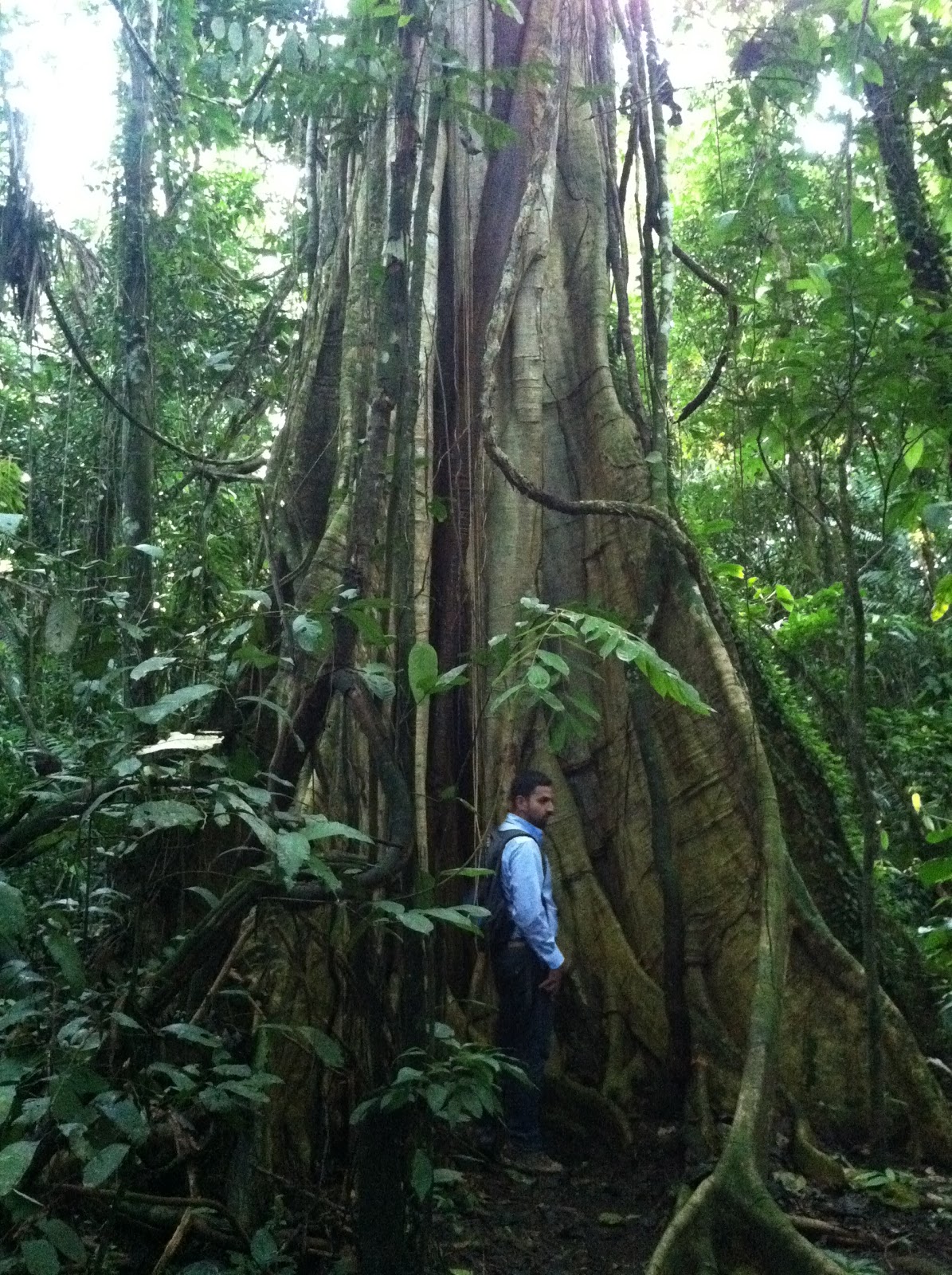
My friend by the base of a tall ceiba tree.
Myself at the canopy of a ceiba.
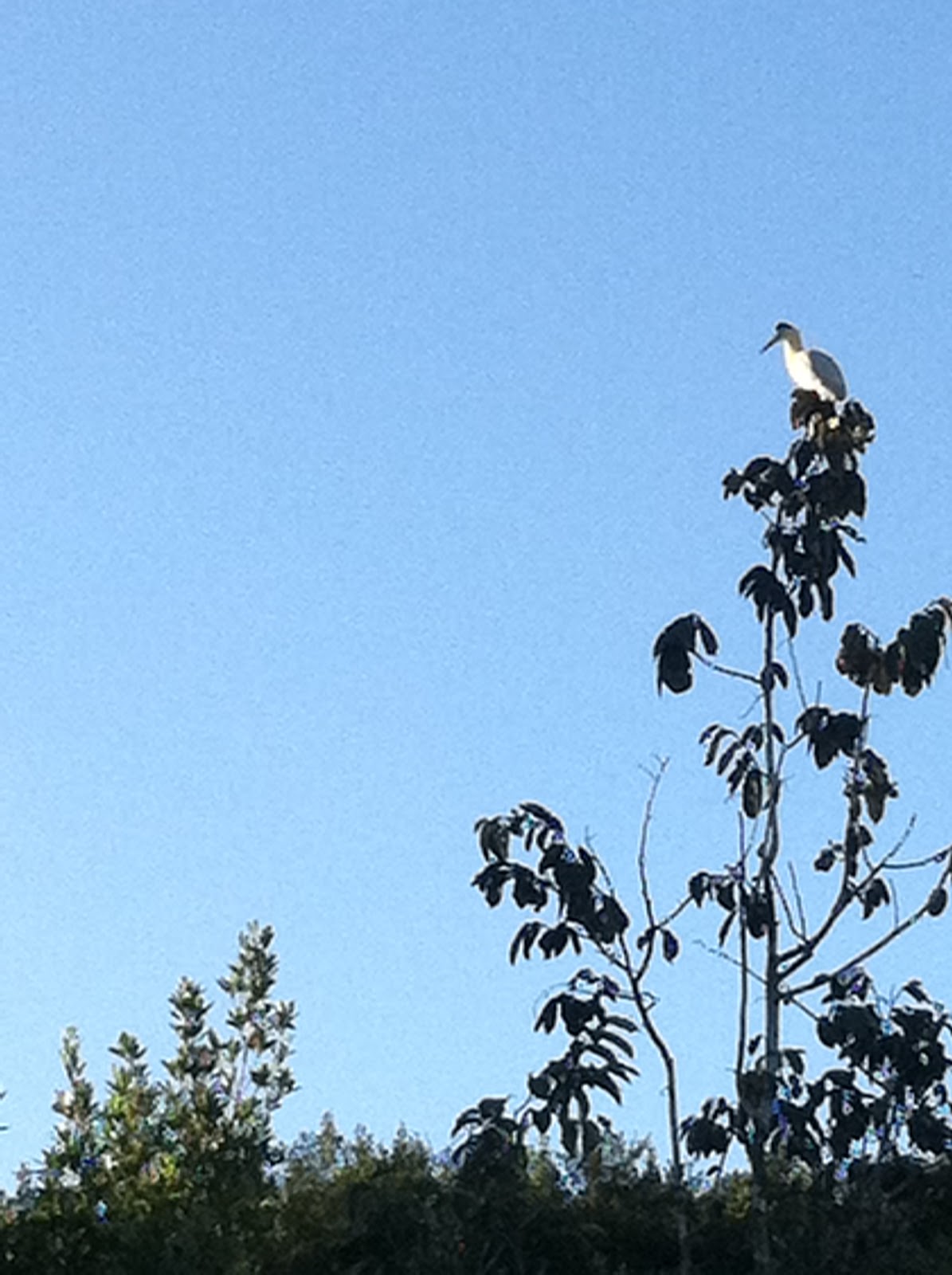
Capped Heron (Piherodius pileatus)
A species of Amblypigid, or tailless whip scorpion, an arachnid related to spiders and true scorpion. This one was the size of my hand.
Guides from the Napo Wildlife Center. The gentleman on the right is a native of the Kichwa Añangu community.
And please consider donating to the Yasuní-ITT Trust Fund! Show Ecuador and the world that there is an alternative to destructive and irreversible oil development, and that we care.
From the Hall of Human Origins, National Museum of Natural History, Washington DC.
Ecuador is one of the top producers of bananas and the largest exporter of this fruit*. Plantain (which, like banana, is a domesticated and sterile hybrid of two species of plants from the genus Musa) is a prevalent staple in the cuisine of the Ecuadorian coastal region, eaten green or ripe, fried, baked, in soups, with ceviche, eaten with breakfast, lunch or dinner. The wild ancestors of these fruits contain seeds, and like many inter-species hybrids, bananas and plantains are sterile, and in this case seedless, which is a desirable trait for an edible fruit. How are they propagated then, with no seeds? Bananas and plantains must be reproduced from cuttings of the underground stem. Since there is no sexual reproduction involved, there is very little genetic diversity among banana cultivars, and thus there is concern that this important crop plant can become vulnerable to disease and it would be difficult to generate resistant clones. Efforts are underway to increase the genetic diversity of bananas and plantains to make this a stable food source for consumers and source of income for farmers.